
Fresh Beef Cat Food
Real meat. Real beef. Exactly what a carnivore's body is built to run on
Cats are obligate carnivores and need real meat to stay healthy, energetic and playful. But most "beef" cat food is mostly grain, sugar and fillers, with much less meat than you'd expect.
Benefits of beef cat food

Steady, all-day energy - Beef is naturally high in protein and iron, giving your cat real fuel rather than a sugar-crash from carb fillers.
A shinier coat - Natural fats and moisture keep skin and coat in good condition, without the extra carbs.
Fewer hairballs, firmer poops - Without grains and fillers, our beef recipe is easier for most cats to digest, with less mess and smell left in the litter tray.
Vet-formulated for complete nutrition - Every recipe is designed to be complete and balanced, giving your cat everything they need.
A calmer tummy - As a single, simple protein, beef is often used to help spot food sensitivities, making it a solid pick for cats prone to an upset stomach.
Real beef cat food should taste like real beef: rich, energising and unmistakably meaty. Most "beef" cat food on the shelf doesn't. It's grain and filler first, beef second, which defeats the point for an animal built to run on meat.
That's why cat food without grains matters so much. KatKin's beef is gently cooked at 90°C, made fresh daily in our Suffolk kitchen, with no fillers, no grains and no sugar.
Beef is also one of the richest natural sources of taurine (especially in cuts like heart), an amino acid cats can't make enough of on their own and need from their food. It's exactly why real high protein cat food matters so much for an obligate carnivore.
Katkin’s fresh beef cat food

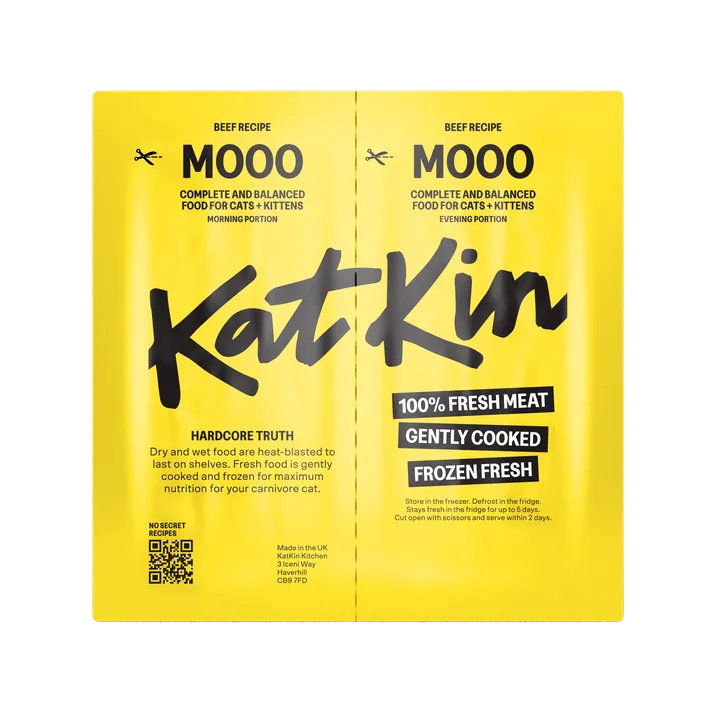
KatKin's beef recipe is called Mooo. It's built around three simple ingredients: beef trim, heart and liver, gently cooked to lock in the good stuff, then flash frozen to protect the nutrients until it reaches your fridge. Per 100g, that works out at 157 calories, 17.2% protein and 10.2% fat, so there's real substance behind the "high protein" label, not just a claim on the box.
Every box is personalised around your cat: their age, weight, activity level and any allergies or health conditions factored in, so the nutritional balance is exactly right for them. Then it's delivered on ice straight to your door. No guesswork, no faffing about with scales, just 100% grain-free beef cat food.

Choosing the best beef cat food for your feline friend
Not every cat needs (or wants) the same thing, which is why it helps to know what you're looking for before you buy.
Start with the ingredient list. It should be short: real beef, with named organs like heart and liver, and no fillers or grains. If you can't picture the ingredient sitting on a butcher's counter, it probably shouldn't be in the bowl.
You'll also see buzzwords like "natural", "organic" or "grass-fed" on labels. They sound reassuring, but they're not always regulated or meaningful on their own. What matters more is transparency: pure ingredients, succulent cuts and nutrient-rich offal, just like carnivore cats eat in the wild, rather than vague "meat derivatives" hiding in the small print.
Some cat parents consider a homemade beef diet, hoping for more control over their cat’s nutrition. But balancing vitamins, minerals and taurine correctly without expert formulation is difficult to get right. A fresh, vet-formulated recipe like Mooo gives you the same real-meat benefits, minus the guesswork.
If your cat fancies trying something new, KatKin's lamb and beef cat food recipes are worth comparing side by side. If you're after a different flavour, such as chicken or duck, check out our product range.
A Gently Cooked Alternative to Raw Beef Cat Food

Raw beef cat food has a loyal following, and it's easy to see why: it's unprocessed, high in meat and close to what a cat would hunt in the wild.
But raw diets carry real risks. Bacteria and parasites, including organisms like Toxoplasma, can survive on raw meat, putting both your cat and anyone who handles their food at risk. Getting the nutrient balance right without expert formulation is harder than it looks too. An imbalanced raw diet can cause real problems over time, no matter how natural it looks on paper.
KatKin cooks each recipe at 90°C, hot enough to kill harmful bacteria and parasites, but gentle enough to keep the nutrients intact. You get the same nutrient-rich, close-to-nature quality cat parents want from raw beef, without the risk that comes with it.
Beef kitten food

Kittens can eat beef too, as long as the recipe is formulated for their extra nutritional needs. Growing kittens need more protein and calories relative to their size and beef's naturally high protein content, along with taurine from cuts like heart, supports healthy growth from an early age.
KatKin's recipes are formulated by our in-house vet nutritionist team to suit cats and kittens alike, so there's no need for a separate "kitten-only" product as your cat grows.
Fresh vs wet & dry beef cat food
Wet beef cat food usually comes as a pate or shredded in a sauce, cooked at high temperatures for a long shelf life. Dry beef kibble goes even further, needing fillers and carbohydrates to hold its shape.
Both can list "beef" on the front of the pack while containing surprisingly little of it once you check the label. Fresh beef cat food skips that trade-off entirely. It's gently cooked to be safe, then kept in the fridge rather than a tin or a bag, so more of the original meat, moisture and nutrients make it into the bowl.
Beef vs other proteins

It's a good pick if your cat loves a rich, red-meat flavour, or if their tummy doesn't get on with more common proteins like chicken or fish.
It might not be the best fit if your cat has a specific medical condition that calls for a different protein or fat profile, or if they've simply never been a fan of red meat. Some cats hold out for chicken, turkey or fish.
If you're not sure beef is the right call, it's worth browsing all cat food to compare the full range before you decide.
Transitioning Your Cat to Beef-Based Food

Even a positive change, like switching to fresh, is still a change and most cats prefer to ease into new food gradually. We’d recommend incorporating these helpful tips into your cat’s feeding routine:
Start small. Mix a little of Mooo into their current food – roughly a quarter to three-quarters old food at the start
Increase gradually. Every two to three days, shift the ratio further towards beef, watching how they respond.
Watch the basics. Keep an eye on appetite, stools and energy levels as the balance changes.
Give it time. Most cats adjust within seven to ten days, though fussier cats may take a little longer.
Ask for help if needed. If your cat has allergies, a health condition or simply won't budge, a chat with your vet or KatKin's in-house Cat Experts can help smooth things along.
The difference real meat, high protein cat food makes
A far more natural diet
As a parent I'm happy. As a carnivore she's asking why I didn't get this stuff in earlier.
Elaine and Marley

I want the best – that’s KatKin
100% meat with no sugars and fillers – what's not to like? I want the best for my boys and that's KatKin.
Mandy and Willow
She finally enjoys her meals
We were at our wits’ end about Beau’s fussy eating habits. Now she meows for her meals and licks the bowl.
Siobhan and Beau
The best cat food ever
He is livelier, looks healthier, his fur is better. I can’t believe the difference. 100% fresh cooked meat and he loves it.
Melissa and Charlie

If I could give 10 stars
Delivered promptly and in recyclable packaging, all fresh, no nasty fillers. Bubba never leaves any.
Jacqui and Bubba
He’s like a different cat
His fur is thick and shiny. The Sprinkles and Nibbles have to be put away or he tries to open them himself.
Mrs J.H. and Tyler
